ClusterProfile API Overview
This document provides an overview of the ClusterProfile API.
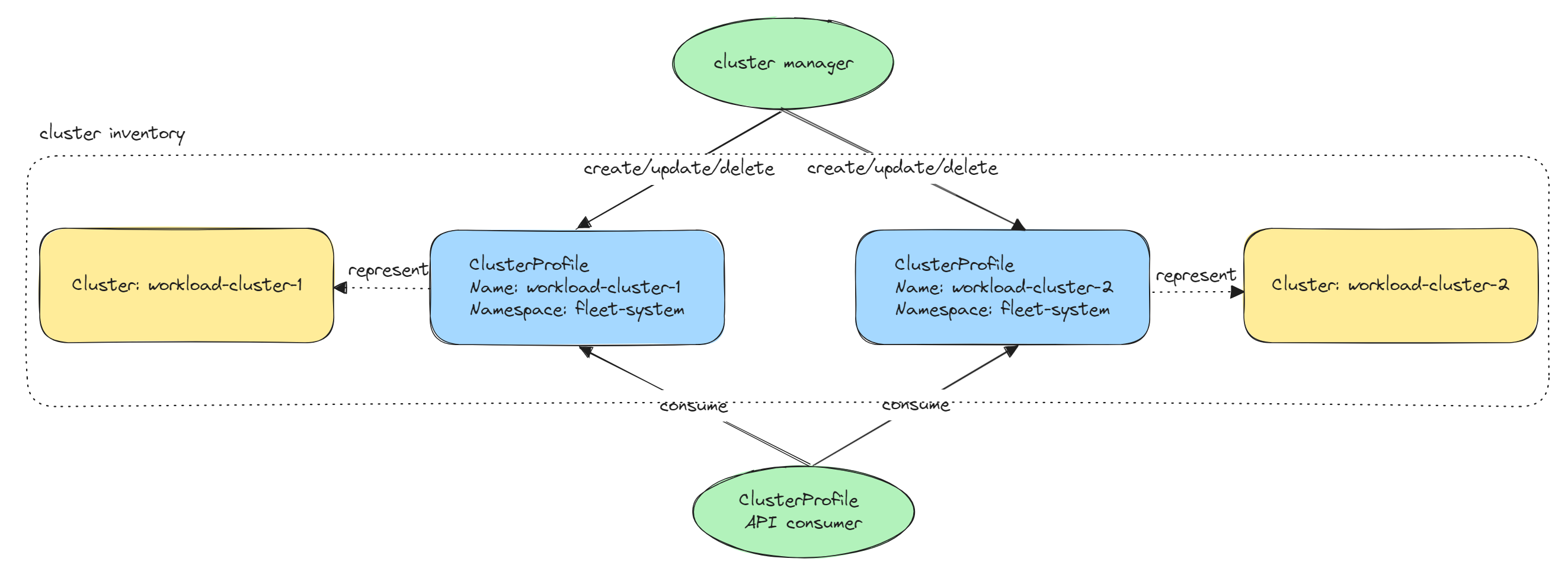
A Cluster Profile is a namespace-level resource and essentially represents an individual member of the Cluster Inventory that details properties and status of a cluster. This API proposes a standardized interface that defines how cluster information should be presented and interacted with across different platforms and implementations.
You can read more details about the API in the KEP-4322.
Terminology
-
Cluster Inventory: A conceptual term referring to a collection of clusters. A cluster inventory may or may not represent a ClusterSet. A cluster inventory is considered a clusterSet if all its member clusters adhere to the namespace sameness principle.
-
Cluster Manager: An entity that creates the ClusterProfile API object per member cluster, and keeps their status up-to-date. Each cluster manager MUST be identified with a unique name.
Each ClusterProfile resource SHOULD be managed by only one cluster manager. A cluster manager SHOULD have sufficient permission to access the member cluster to fetch the information so it can update the status of the ClusterProfile API resource. -
ClusterProfile API Consumer: the person running the cluster managers or the person developing extensions for cluster managers for the purpose of workload distribution, operation management etc.
Access to member clusters (status.accessProviders)
ClusterProfile describes a cluster, but it does not define a single universal way to authenticate to that cluster. Different environments have different credential sources (cloud IAM tokens, in-cluster Secrets, external identity systems, etc.).
To make multicluster controllers interoperable, status.accessProviders standardizes the reachability details for a cluster
and provides enough information for a consumer to select an external credentials provider mechanism (plugin) to obtain credentials.
- What
accessProvidersis: A list of named access provider entries. Each entry represents one way a consumer can connect to the member cluster. name: The access provider type identifier (for examplegoogleorsecretreader). Consumers can use this value to select a matching credential provider plugin.-
cluster: Connection details that reuse the kubeconfigClusterschema (for exampleserver,certificate-authority-data,proxy-url). -
What
accessProvidersis not: It is not a place to store credentials. Tokens, client certs, and other secrets should not appear in ClusterProfile. Consumers are expected to obtain credentials out-of-band, typically via an exec-style credential provider plugin as described in KEP-5339.
Selecting an access provider
status.accessProviders is written by the cluster manager (or its extensions) and treated as read-only by consumers.
If multiple access providers are present, consumers typically select an entry by name based on what credential provider plugins they support.
Plugin configuration (cluster.extensions)
Some credential providers need extra parameters (for example a clusterName) in order to fetch credentials.
These parameters should be per-cluster and non-secret, and must not include controller- or environment-specific data.
When plugin-specific per-cluster configuration is needed, use the Kubernetes client authentication API exec plugin mechanism.
See the reference for the exact schema and semantics:
client authentication API: Cluster.config for exec plugins
API Example
apiVersion: multicluster.x-k8s.io/v1alpha1
kind: ClusterProfile
metadata:
  name: some-cluster-name
  namespace: fleet-system
  labels:
    x-k8s.io/cluster-manager: some-cluster-manager
spec:
  displayName: some-cluster
  clusterManager:
    name: some-cluster-manager
status:
  version:
    kubernetes: 1.28.0
  properties:
    - name: clusterset.k8s.io
      value: some-clusterset
    - name: location
      value: apac
  accessProviders:
    - name: secretreader
      cluster:
        server: https://api.some-cluster.example:6443
        certificate-authority-data: <base64-encoded-ca>
        extensions:
          - name: client.authentication.k8s.io/exec
            extension:
              clusterName: some-cluster-name
  conditions:
    - type: ControlPlaneHealthy
      status: True
      lastTransitionTime: "2023-05-08T07:56:55Z"
      message: ""
    - type: Joined
      status: True
      lastTransitionTime: "2023-05-08T07:58:55Z"
      message: ""